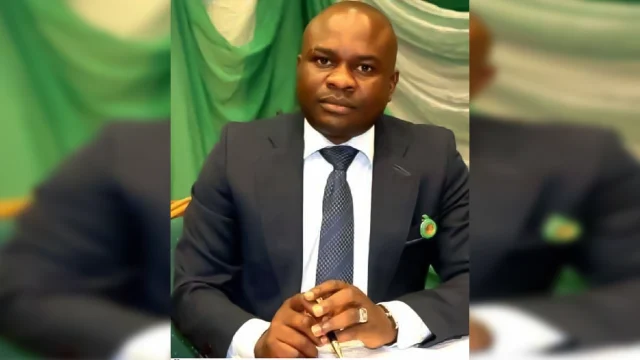
Rivers State African Democratic Congress (ADC) governorship aspirant, Dr. Farah Dagogo, has outlined his governance vision, focusing on accountability, youth empowerment, security reforms, and institutional development, while defending his defection to the ADC.
Excerpts:
Rivers State remains one of Nigeria’s richest oil-producing states, yet unemployment, insecurity, and infrastructure deficits persist. What would be your top three priorities if elected governor?
When elected, every sector will receive strategic attention because Rivers State has experienced a prolonged decline in governance and public administration. The state cannot afford to be in bondage for another four years. Rivers people deserve a new direction, a fresh vision, and a governance model aligned with the aspirations of the founding fathers.
My administration will be guided by the principles of Diplomacy, Information, Security, and Economy (DISE), a framework designed for inclusive and people-oriented governance.
The DISE framework will prioritize education reform, healthcare development, youth empowerment, security enhancement, agricultural modernization, job creation, infrastructure renewal, housing, and investment promotion.
A key initiative will be the establishment of a Youth Entrepreneurship Development Trust Fund, backed by legislation, with at least five percent of the state’s annual capital budget dedicated to young entrepreneurs.
In education, we will adopt STEAMS—Science, Technology, Engineering, Arts, Mathematics, and Sports—to equip young people with globally competitive skills.
On security, we will ensure transparent and efficient use of security funds, ending their use as political tools, while adopting intelligence-driven and community-based strategies.
Rivers politics is deeply divided. How would you restore unity if elected?
The solution is simple: return power to the people. Democracy belongs to the citizens, not political godfathers. Governance must be based on dialogue, inclusion, and consensus-building.
My administration will prioritize inclusive governance and ensure no group monopolizes power. Rivers State needs healing, reconciliation, and restoration of democratic values. Governance will be people-driven, transparent, and anchored on fairness and justice.
What is your position on the Court of Appeal ruling regarding EFCC’s powers over Rivers State finances?
This legal issue dates back nearly two decades. The 2007 judgment stemmed from constitutional interpretations on state financial autonomy, and it was never properly appealed.
Beyond the legal debate, accountability must not depend solely on federal anti-corruption agencies.
Strong state institutions such as the House of Assembly, Auditor-General, and Accountant-General must be empowered.
If elected, I will strengthen these institutions, ensure independence, and institutionalize transparency and financial oversight in governance.
Why did you leave the PDP and join the ADC?
Leaving the PDP was difficult due to my history with the party. However, internal crises, power struggles, and exclusion of key stakeholders weakened the party over time.
My move to the ADC is driven by conviction, not survival. The ADC represents an opportunity to rebuild democratic values, strengthen institutions, and promote people-centered governance.
Nigeria’s challenge is weak institutions and overconcentration of power in individuals. The ADC seeks to reverse that by promoting accountability, rule of law, and democratic reforms.
How do you respond to critics who say your defection is politically motivated?
My record speaks for itself. Despite challenges within the PDP, I remained loyal and worked for the party’s success, delivering my local government area across all elections in 2023.
That demonstrates commitment beyond personal ambition. My move to the ADC is based on the need for a credible platform aligned with my vision for institutional reform and development in Rivers State.